Logo of MERLOT Journal of Online Learning and Teaching.

Compliments of PixLjUicE23

“Real security comes from a connection to that which is secure – the spirit. “ [Heart at Work].

Mess most often results in duplicates from the simple fact that we don’t know what we have. I saw this principle most prominently showcased in a television segment about hoarding, in which a woman was unable to find a birthday gift in her avalanche of belongings. In straightening my personal living space I was surprised to find six containers of poultry spice (three of which were brand new). This was a revelation, considering that I don’t use this condiment. Turn the page…
Share |

Logo of MERLOT Journal of Online Learning and Teaching.

Compliments of Kyle and Kelly Adams, via Flickr

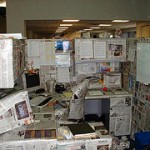
Dr. Sam Gosling, psychology professor at The University of Texas at Austin describes “behavioral seepage” as clues we leave by the type, amount, and condition of the items with which we surround ourselves. He’s a psychological anthropologist of sorts, a visual sleuth who scans individual living spaces to determine something about the personality of its inhabitant. He found for example (not surprisingly) that conscientious individuals have neat, clean, and organized offices.

Others are however more oblivious and apathetic regarding the presentation they make. Gosling’s (2008) research got me thinking about the personality of individuals who maintain messy offices, and in particular, those whose mess is visible to everyone around them – like in a cube or a bull pen environment. Coworkers see the imposition of your stuff like a silent parade that precedes you. Turn the page…

Share |